2025 Math Kangaroo Real Questions and Analysis
In this article, you’ll find:
- A topic distribution chart for the 2025 Math Kangaroo Levels 1–4
- Key concepts tested in each topic
- A question–module mapping table
- Several real 2025 questions with solutions and common mistakes
- Study tips and resources to prepare effectively for Math Kangaroo
2025 Math Kangaroo Overview
The Math Kangaroo competition consists of a single 75-minute multiple-choice test with five answer options per question. Students can participate either online or on paper.
Scoring Structure
- Grades 1–4: 24 questions, maximum score of 96 points
- Grades 5–12: 30 questions, maximum score of 120 points
Learn more about Math Kangaroo Format and Scoring Here: Math Kangaroo FAQ and Resources: Your Ultimate Guide
Levels 1-2 Analysis
Topic Distribution
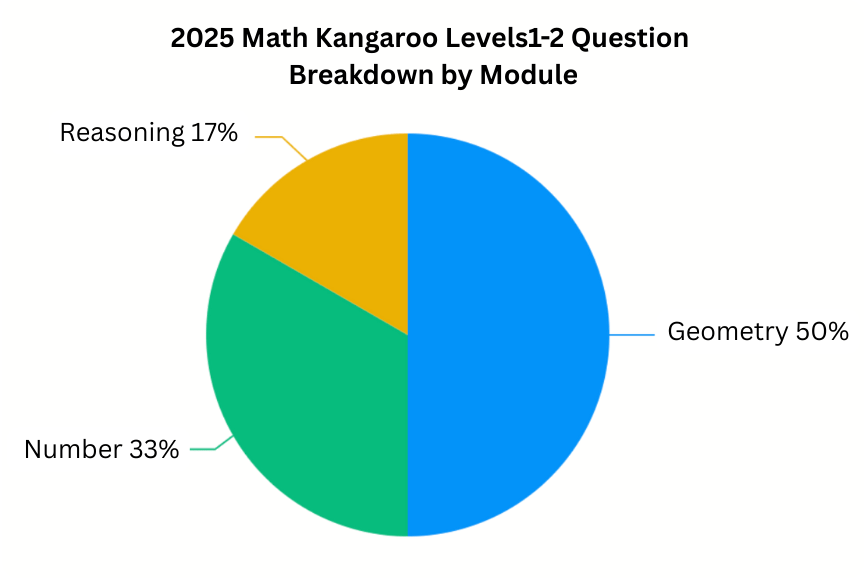
The 2025 Math Kangaroo Levels 1-2 exam places a strong emphasis (half 50%) on geometric and spatial thinking, while also valuing foundational number sense and logical reasoning skills.
Detailed Module Summary
| Module | Question Numbers | What It Tests |
|---|---|---|
| Geometry | Q2, Q3, Q4, Q5, Q6, Q8, Q9, Q10, Q11, Q16, Q22, Q23 | 2D & 3D shapes, grids and paths, counting squares, cube stacks, coloring logic |
| Number | Q1, Q12, Q13, Q14, Q18, Q19, Q20, Q24 | Basic operations, word-problem equations, unit price, ages & weights, multiples, worst-case |
| Reasoning | Q7, Q15, Q17, Q21 | Elimination, sequential reasoning, repeating patterns, sudoku |
Real Questions and Solutions Explained
Geometry Example – Problem 9
Question:
Two rubber bands are placed around a stack of 18 cubes. How many cubes are not touching a rubber band?

(A) 6 (B) 8 (C) 9 (D) 10 (E) 12
Solution:
- See the stack as a 3 × 3 × 2 block (9 cubes per layer).
- Notice the horizontal band wraps around the middle and touches all cubes on the top layer.
- The vertical band touches a full column of cubes (1 column × 2 layers).
- On the bottom layer, 3 cubes are touched by the vertical band → 6 bottom cubes remain untouched.
- So 6 cubes do not touch any rubber band.

Answer: A
Common Mistakes:
- Only counting cubes visible in the picture.
- Assuming the bottom layer is completely free of bands (or same as the top).
- Double-counting cubes touched by both bands when reasoning.
- Ignoring the vertical band’s effect.
- Not organizing the stack as 3 × 3 × 2 and instead guessing.
Number Example – Problem 20
Question:
3 years ago, the sum of Ana’s age and Ben’s age was 6 years. Ana is currently 7 years old. How old is Ben now?
(A) 1 year (B) 5 years (C) 6 years (D) 7 years (E) 11 years
Solution:
This is an age problem. First, calculate the sum of ages this year, then calculate Ben’s age. Note that the sum of ages is doubling. Three years ago, the sum of the ages was 6, so three years later, the sum of ages increases by 6. The current sum: 6+3+3=12. Ben: 12-7=5.
Answer: B
Common Mistakes:
- Using Ana’s current age (7) instead of 4 when the sum is “3 years ago.”
- Misreading “sum of their ages was 6” as “their ages were both 6” or using only one child’s age.
- Guessing by trial without checking the “3 years ago” condition.
Reasoning Example – Problem 7
Question:
On Michael’s toy shelf, there are no turtles, no rabbits, and no robots. Which of these shelves could be Michael’s shelf?

Solution:
- List the forbidden toys: turtle, rabbit, robot.
- Check each shelf:
- A: has a rabbit → eliminate.
- C: has a turtle and robots → eliminate.
- D: has a robot → eliminate.
- E: has a turtle and a rabbit → eliminate.
- Only B has none of the forbidden toys (horse, bear, dog).
Answer: B
Common Mistakes:
- Misreading “no turtles, no rabbits, and no robots” as allowing one of them or just “not all three”.
- Looking quickly and missing a small turtle or robot in the picture.
Levels 3-4 Analysis
Topic Distribution
The 2025 Math Kangaroo Levels 3–4 exam places its strongest emphasis on Geometry (50%), with additional focus on Combinatorics (20%), Word Problems (17%), and Number (13%), highlighting the importance of spatial reasoning and counting skills alongside solid basic arithmetic and problem-solving.

Detailed Module Summary
| Module | Question Numbers | What It Tests |
|---|---|---|
| Geometry | Q1, Q3, Q4, Q5, Q6, Q7, Q8, Q12, Q16, Q18, Q19, Q21 | Counting Solid Shapes, Rolling the Dice, Complex Pattern, Direction and Position, Cutting and Rearranging Shapes, Three View, Perimeter |
| Number | Q2, Q9, Q14, | Addition and Subtraction, Division |
| Word Problem | Q10, Q13, Q17, Q20, | Sum-Multiples Problems, Calendar and Period |
| Combinatorics | Q11, Q15, Q22, Q23, Q24 | Figure Decipher, Equivalent Substitution, Number Matrix |
Real Questions and Solutions Explained
Geometry Example – Problem 5
Question:
On a regular die, the total number of dots on two opposite faces is always 7. Which one of the dice shown below can be a regular die?

Solution:
On a standard die, the numbers on opposite faces add up to 7, meaning 1 is opposite 6, 2 is opposite 5, and 3 is opposite 4. Opposite faces cannot be adjacent.
Option B: 2 and 5 are adjacent → eliminate.
Option C: 1 and 6 are adjacent → eliminate.
Option D: 3 and 4 are adjacent → eliminate.
Option E: 2 and 5 are adjacent → eliminate.

Answer: A
Common Mistakes:
- Forgetting that opposite faces total 7, not that adjacent faces do.
- Not checking the impossible pair rule (1–6, 2–5, 3–4 can’t be adjacent).
- Guessing based only on face numbers rather than die structure.
Number Example – Problem 14
Question:
Tom wants to divide a pizza into halves. He also wants to have the same number of tomatoes on each half. Is it possible for him to do this with two different cuts. Along which lines could he cut?

(A) 1 and 3 (B) 1 and 4 (C) 2 and 3 (D) 2 and 4 (E) 3 and 4
Solution:
The total number of tomatoes on the pizza is: 5 + 1 + 2 + 1 + 4 + 2 + 3 = 18.
Dividing the pizza into 2 halves, each half should have: 18 ÷ 2 = 9 tomatoes.
So cutting along line #2 or line #4 meets the requirement.
Answer: D
Common Mistakes:
- Relying on visual symmetry and not counting tomatoes on each half.
- Checking slices instead of entire halves.
- Thinking “two different cuts” means any two lines once one works, without verifying both.
Word Problem Example – Problem 20
Question:
The picture shows the page for one month of a calendar without any of the dates. The total of the dates for the 2 shaded days is 29. On what day of the week does the first day of the month fall?

(A) Monday (B) Tuesday (C) Wednesday (D) Thursday (E) Sunday
Solution:
From the calendar, we can see that the shaded dates are 13 days apart; from the given conditions, the sum of the two dates is 29.
So the earlier date is: (29 − 13) ÷ 2 = 8
The later date is: (29 + 13) ÷ 2 = 21
Fill in the dates on the calendar; the 1st day of this month is Thursday.


Answer: D
Common Mistakes:
- Treating the two shaded squares as 7 days apart (same weekday one week later) instead of 13 days apart per the grid.
- Thinking they’re 14 days apart (two full weeks), misreading the relative positions.
- Using the sum 29 but averaging incorrectly (e.g., taking 29÷2) rather than (29±13)÷2.
Combinatorics Example – Problem 11
Question:
In the morning, 5 friends had identical fully-charged mobile phones. By the evening, Bob had spoken on the phone as much as Ann and Cristina together. Bob ran out of power. David had not used his phone at all. Which phone belonged to Edward?

(A) 1 (B) 2 (C) 3 (D) 4 (E) 5
Solution:
Bob ran out of power → phone #3. David had not used his phone at all → phone #1. Bob had spoken on the phone as much as Ann and Cristina together. This means Ann and Cristina used up the same total battery as Bob; the battery used by phones #4 and #5 together equals the battery Bob used (#3), so phones #4 and #5 belong to Ann and Cristina.
From the above reasoning, Edward’s phone is #2.
Answer: B
Common Mistakes:
- Mixing up who used which phone — e.g., assuming David’s unused phone is the one with some charge left (not full).
- Forgetting that Bob’s total usage = Ann + Cristina’s combined, so their total battery drain must equal Bob’s.
2025 Math Kangaroo Answer Key
| Question | Level 1 & 2 | Level 3 & 4 |
|---|---|---|
| 1 | C | A |
| 2 | E | E |
| 3 | E | E |
| 4 | A | E |
| 5 | B | A |
| 6 | C | B |
| 7 | B | A |
| 8 | E | E |
| 9 | A | E |
| 10 | E | C |
| 11 | D | B |
| 12 | B | B |
| 13 | C | B |
| 14 | C | D |
| 15 | D | C |
| 16 | D | E |
| 17 | B | D |
| 18 | D | B |
| 19 | D | D |
| 20 | B | D |
| 21 | A | B |
| 22 | C | C |
| 23 | A | A |
| 24 | C | C |
Best Resources to Prepare for Math Kangaroo
Visit our All-in-One Math Kangaroo Hub for free and exclusive preparation materials, including video explanations, worksheets, and topic breakdowns.
About Think Academy
Think Academy, wholly owned by TAL Education Group, specializes in preparing students for the Math Kangaroo competition. Each year, over 300 Think Academy students win Math Kangaroo awards, including 35% of all Level 1 perfect scores nationwide. 7 out of 10 Think participants won national awards in 2025. Supported by world-class resources and expert coaching, we empower students to achieve exceptional results in international mathematics competitions.
Want more insights on math education and parenting tips? Subscribe to our newsletter for weekly expert advice and updates on the latest learning tools.

Leave a Comment & Share Your Thoughts!

Share This Story, Choose Your Platform!
Related Posts


