A King, a Goldsmith, and a Suspicion
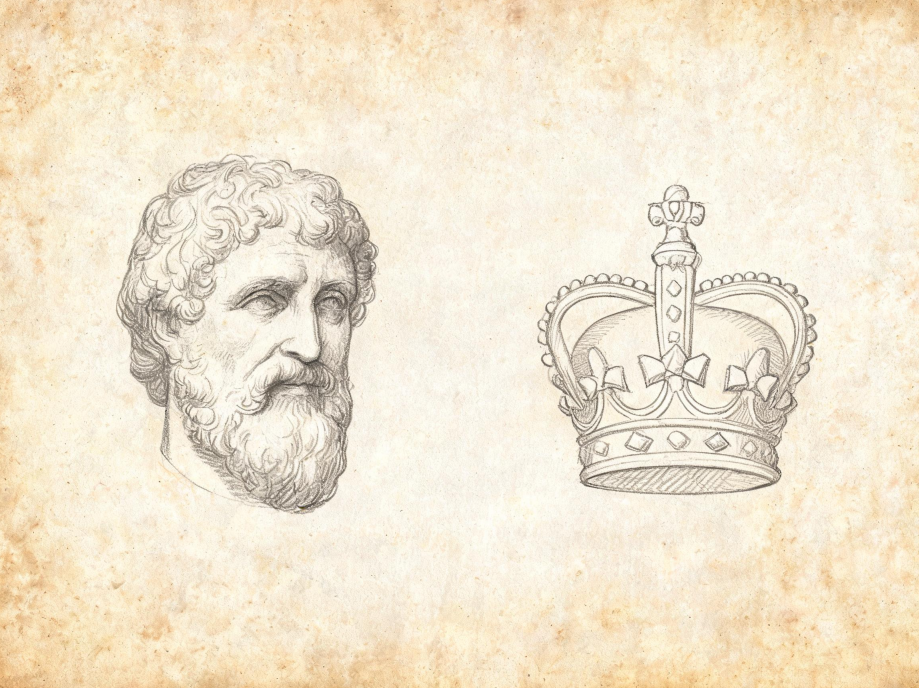
Here’s the setup: Around 250 BCE, King Hiero II of Syracuse commissioned a golden crown for a temple. He handed the goldsmith a precise weight of pure gold. Then he waited.
The crown came back on time. It looked beautiful. But something felt off.
The king weighed it, and the weight matched perfectly. Yet the king still suspected a trick. What if the goldsmith had swapped some gold for silver — and kept the difference for himself?
There was a problem: the weighing results were not accurate enough. Silver is lighter than gold. Therefore, the forger only needs to add sufficient silver to make the weight of the fake crown equal to that of the original gold crown, thus deceiving everyone. However, the balance cannot distinguish the difference.
Worse, nobody could melt the crown down to test it. Destroying a sacred object wasn’t an option. So the king needed an answer without damaging the crown. He called in Archimedes, Syracuse’s best problem-solver and mathematician.
The Problem That Stumped Everyone
Think about what Archimedes was actually asked to do.
At that time, mathematicians knew how to find the volume of regular shapes — cubes, spheres, cones. But a crown is a twisty, leafy, irregular object. There was no formula for that. And without the volume, you couldn’t check the crown’s density. Without the density, you couldn’t tell gold from a gold-silver mix.
So the question sat in Archimedes’ head. Then one day, he did something ordinary. He took a bath.
The Eureka Moment
As Archimedes lowered himself into the tub, water spilled over the edge. Nothing new there. But this time, he looked at the water differently.
The amount of water that overflowed matched the volume of the part of his body underwater. His body had pushed the water out of the way. Therefore, the water gave him an exact measurement of his own volume — no formula needed.
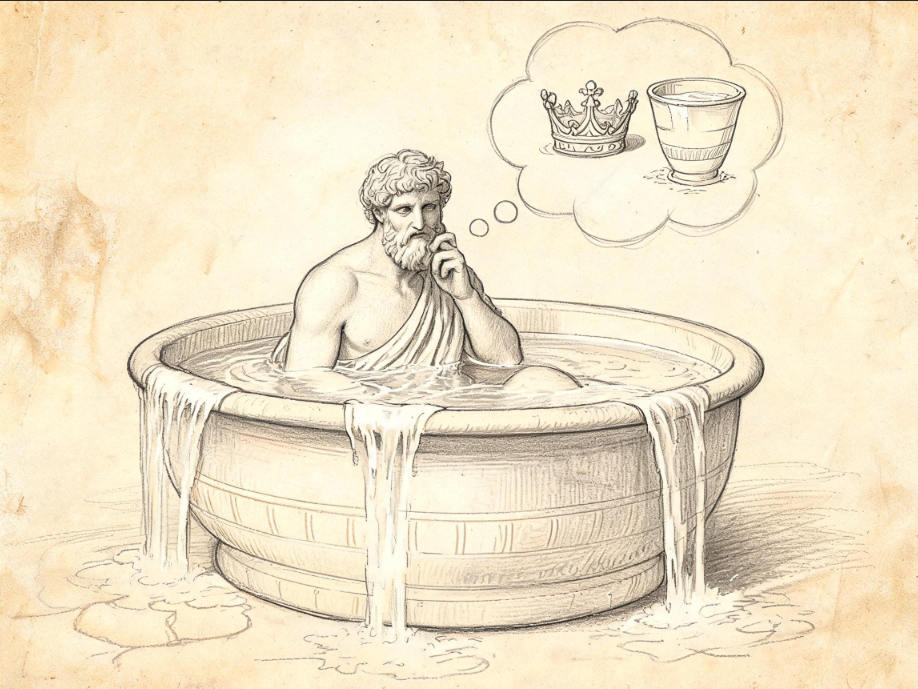
That is precisely the point. If water can measure the volume of an object, it can also measure the volume of a crown.
According to legend, Archimedes was so excited that he jumped out and ran through the streets shouting “Eureka! Eureka!” — Greek for “I have found it!” (Reportedly without stopping to dress. History is silent on how the neighbors felt.
The Test — And the Math Trick Inside It
Here’s how Archimedes reportedly solved the king’s problem. The method is simple, but the logic is brilliant.
📌Step 1: Take a lump of pure gold and a lump of pure silver. Each one weighs the same as the crown.
📌Step 2: Dip each lump into a full container of water. Measure how much water spills out.
📌Step 3: Now dip in the crown itself.
Then comes the comparison — and this is where the math does the detective work.
Gold has a high density, while the density of silver is much lower – approximately half that of gold. Therefore, a pound of silver occupies about twice the space of a pound of gold. This results in the silver block expelling more water than the gold block. And as for the crown? It expels more water than pure gold.
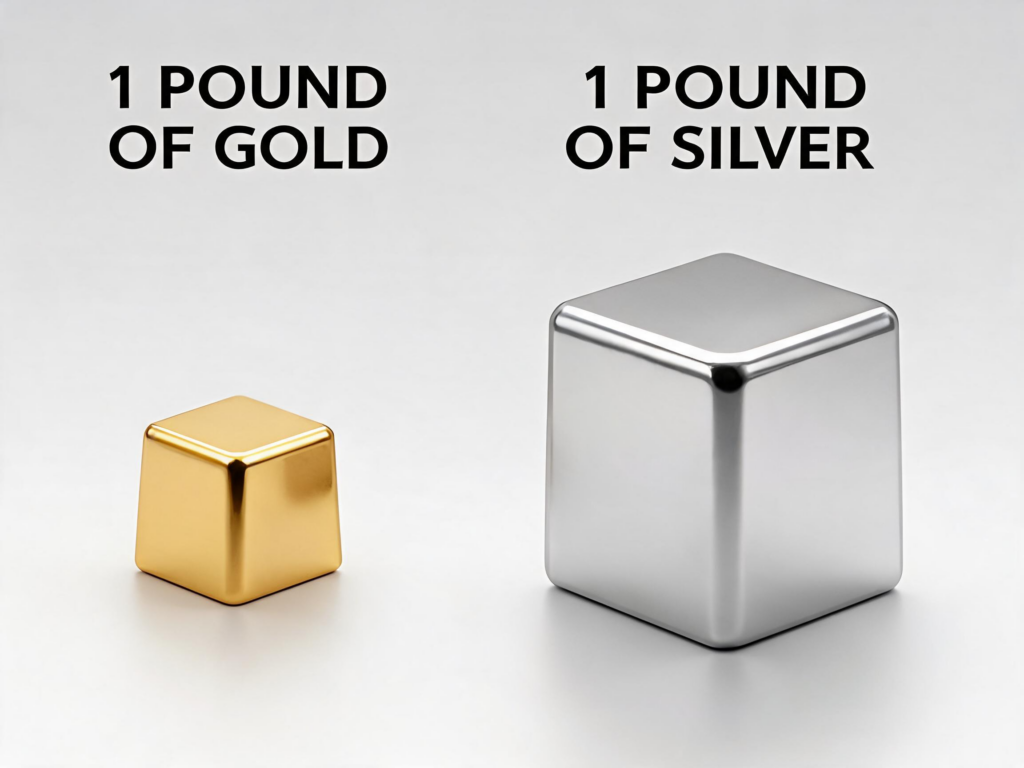
That could only mean one thing. The crown was bulkier than pure gold of the same weight. Therefore, something lighter than gold was mixed in. The goldsmith was caught.
No formulas. No melting. Just water, a scale, and careful reasoning.
The Twist Your Textbook Skipped
But here’s the part most versions leave out. The story might not have happened exactly this way.
The tale first appeared in writing about 200 years after Archimedes died, in the Roman architect Vitruvius’ book “De Architectura“. Archimedes himself never wrote it down. So historians treat it as a legend — a beloved one, yet still a legend.
There’s also a practical problem. If the goldsmith swapped in only a small amount of silver, the difference in spilled water would be tiny — a few spoonfuls at most. Measuring that precisely, with ancient tools, would have been nearly impossible.
Interestingly, Galileo pointed this out in 1586. He argued that Archimedes more likely used a smarter version: hang the crown and an equal weight of pure gold on a balance scale, then dip both into water at the same time. If the crown contained silver, the scale would tip. That method needs no measuring cup at all — just a sharp eye and a steady hand.
So maybe the bathtub gave Archimedes the idea. However, the final test was probably the balance, not the spill.
Either way, the core insight stands: an object underwater pushes away exactly its own volume of water. That single idea still powers everything from measuring your kid’s rock collection to designing cargo ships.
Try It at Home (Yes, Really)
This is a perfect 10-minute kitchen experiment for a G5–G6 student:
📌1. Fill a measuring cup with water. Note the level — say, 200 mL.
📌2. Drop in a small waterproof object, like a marble or a coin. Make sure it sinks fully.
📌3. Read the new level. If it now says 235 mL, the object’s volume is 35 mL — or 35 cm³.
That’s it. You just measured the volume of an irregular object, the same way Archimedes did. Meanwhile, your child learns that “volume” isn’t just a formula on a worksheet — it’s real, visible, and touchable.
However, there is something to keep in mind: If the object is going to float, you need to gently push it into the water. Otherwise, you’re only measuring the underwater part.
Why This Story Still Matters for Math Learners
The crown problem isn’t really about water. It’s about how mathematicians think when the formula runs out.
The weight matched, so the obvious check failed. But Archimedes refused to stop at the obvious.
There is no formula to calculate the volume of a crown. So he found a way to measure it without one.
The first version of his solution may not even be the final one. However, the underlying mathematical logical concept has persisted for over two thousand and two hundred years.
That’s the real lesson for students: when one door closes, look for a window. Preferably one with a bathtub behind it.
Think Academy 1-on-1: Where “No Formula” Becomes “No Problem”
School math often stops at the formula. But real math confidence starts when students learn to think through it — exactly what the crown story models.
At Think Academy 1-on-1, our experienced private math teachers build this kind of flexible thinking for students in grades 3 through 10, from core grade-level math to competition prep like AMC 8 and AMC 10:

Whether your child is closing gaps, staying on track, or preparing for advanced placement, a personalized plan makes the difference.






