
Let’s be real — the lead-up to the first day of middle school often feels like total whiplash. One minute you’re pulling all-night video game marathons and chasing the ice cream truck through the neighborhood; the next you’re staring at your class schedule, panicking because you can barely remember what an integer even is. Adjusting back to early bells, packed class periods, and nightly homework takes enough energy on its own — and math adds an extra layer of stress, for good reason.
Math is the ultimate cumulative subject: skip a few key fraction lessons in 6th grade, and 7th grade algebra will look like it’s written in alien code. Zone out during a geometry basics unit, and 8th grade proofs will hit you harder than a surprise dodgeball to the face in PE. The good news? You don’t have to walk into first period math blind. A clear prep checklist cuts down on first-week chaos and makes you feel confident from day one.
Below, we’re breaking down 8 low-lift prep tasks you can knock out before school starts, plus one game-changing tip to keep your math momentum strong all year.
1. Audit Your Previous-Year Math Skills
Skip the urge to crack open the brand-new textbook and power through three chapters before syllabus week — that’s a one-way ticket to back-to-school burnout. Instead, do a quick, low-pressure review of last year’s content to check for wobbly foundations. As you flip through old notes and worksheets, ask yourself:
- Which topics felt so easy I could solve them half-asleep during homeroom?
- Which problem types left me scribbling so many eraser marks I wore holes in my worksheets?
- Which concepts made me go, “Wait, my teacher explained that how again?”
- Can I solve all the basic-level problems for those units without begging Google for answers?
- Pay extra attention to core building blocks: fractions, integers, ratios, equations, geometry basics, and data analysis. The goal here isn’t to master new content — it’s to make sure you don’t carry unaddressed gaps into the new school year.
2. Round Up and Organize Your Math Supplies
We’ve all been there: scrambling to find a pencil two minutes into first period, realizing you left your calculator in your summer camp backpack, or shoving worksheets into your hoodie pocket only to find them crumpled and candy-stained in December. Skip the supply chaos early by gathering all your math must-haves ahead of time:
- A dedicated notebook or binder (the back of your history notebook does not count)
- Reliable pencils and erasers (skip the fancy mechanical pencils that break every two seconds — they’re not worth the flex)
- A ruler and protractor (yes, you will actually use these, we promise)
- A calculator, if your school’s supply list requires it
- Graph paper for messy coordinate plane problems
- A dedicated folder for worksheets, quizzes, and tests
3. Set Clear, Trackable Math Goals
Vague goals like “get an A in math” are about as useful as saying “get really good at skateboarding” without ever practicing ollies. Pick 1-2 small, specific, measurable math goals for the semester, like:
– Boost fraction calculation accuracy to stop losing silly points on easy problems
– Write out every step of my solution instead of jumping straight to the final answer
– Raise my hand to ask at least one question in math class each week, no panic allowed
– Spend 15 minutes reviewing math notes four days a week, instead of cramming the night before quizzes
Tack a note with your goals somewhere you’ll see it (like the cover of your math notebook) and do a quick check-in every other Sunday to see how you’re doing — no guilt if you slip up, just adjust as you go.
4. Rebuild a Consistent Study Routine
(No, You Don’t Have to Study 3 Hours a Day)
If you’ve spent all summer staying up till 2 AM binging shows and waking up at noon, a 7:30 AM first bell will leave you feeling like a sleep-deprived zombie for the first two weeks of school. Ease into a school-friendly routine gently, a week or two before classes start:
- Shift your bedtime and wake-up time 15 minutes earlier each day until you’re synced to the school schedule
- Block off a short, fixed 20-minute window for math practice each day — consistency beats last-minute cramming every time
- Get in the habit of tidying and organizing your notes right after you finish studying, instead of shoving them in your bag never to be seen again
- Save 30 minutes every Friday to flip through the week’s math notes, so you don’t have to re-learn entire units come quiz time.
5. Sneak Math Practice Into Everyday Life
Math isn’t just a random set of problems designed to torture you in class — it’s everywhere, and practicing it in real life feels way less like homework. Work a little number sense into your regular pre-school routine by:
- Calculating the final cost of back-to-school shopping hauls after discounts and tax, so you know if you have enough left for that fancy limited-edition notebook you’ve been eyeing
- Adjusting recipe measurements when baking snacks: if the chocolate chip cookie recipe makes 12 and you want 18, you get to practice fractions *and* eat more cookies. Total win.
- Comparing travel times, routes, and distances when planning weekend hangouts with friends to pick the fastest, most fun option
- Building a simple budget for your allowance, pet-sitting, or lawn-mowing money to save up for that new game, pair of sneakers, or concert ticket you want
These small, fun moments train your brain to think flexibly about numbers, instead of just memorizing steps for a test.
6. Practice Explaining Your Math Thinking Out Loud
Here’s a secret about middle school math: teachers don’t just care if you get the right answer. They care that you understand WHY it’s the right answer — just like your friend won’t believe a new show is great if you can’t explain what makes it fun. Start building this skill before school starts by practicing:
- Writing down every single step of your problem-solving process, even the “obvious” ones
- Naming which rule, formula, or concept you used to move from one step to the next
- Doing a quick sanity check: does your answer make sense? If you calculate that a $50 backpack costs $400 after a 20% discount, you definitely made a misstep somewhere.
- Explaining how you solved a problem out loud to a friend, parent, even your pet — if you can walk them through it without confusing them, you’ve fully got the concept down.
7. Prep for Your First Several Weeks of Math Class
You don’t have to walk in as a math genius on day one, but a tiny bit of prep will help you avoid that “wait, what’s going on?” panic in the first few sessions. Before the first bell:
- Pull up your class syllabus, learning platform links, and teacher contact info so you’re not scrambling for the homework portal 2 minutes before an assignment is due
- Note your teacher’s late work, grading, and participation policies, so you don’t accidentally lose points for a rule you didn’t know existed
- Grab a small notebook (or a dedicated note folder on your phone) to jot down random math questions that pop up as you study, so you don’t forget to ask them in class
- Do a quick brush-up on common middle school math vocab words — nothing throws you off on a first-week exit ticket like forgetting what “coefficient” means
- Once class starts, make a habit of writing down every example problem your teacher walks through, plus their step-by-step solution — those are almost always the exact problem types you’ll see on homework and tests.
8. Know When Extra Personalized Support Makes All the Difference
Let’s get one thing straight: hitting a wall with math doesn’t mean you’re “bad at math.” It just means you might need a little targeted backup to get past that block. Keep an eye out for these signs that you could benefit from extra support this year:
- Math homework takes you hours longer than it should, leaving you burnt out with no time for sports, hobbies, or hanging out with friends
- You can guess the right answer to problems, but you can’t explain WHY it’s right — a habit that always costs you points on tests
- You’re stuck in a cycle of “I’m just not a math person” self-doubt that makes you check out as soon as class starts
- Your quiz and test scores swing wildly: one week you ace every problem, the next you can barely remember how to do long division
- Even your parents are scratching their heads trying to help, because middle school math looks totally different from the content they learned when they were your age
Team Up With Think Academy 1-on-1 to Hit Your Goals Faster
If any of those red flags from step 8 sound familiar, Think Academy’s 1-on-1 online math tutoring is the low-stress, high-impact support you need to thrive this year.
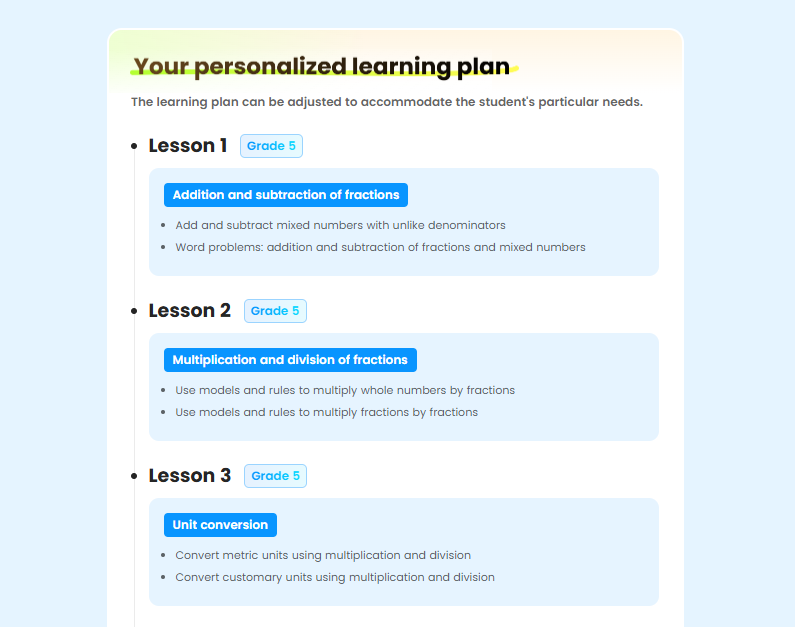
Our elite, experienced tutors don’t just walk you through homework answers — they meet you exactly where you are, patch up those wobbly foundational gaps before they turn into bigger headaches, walk you through how to clearly explain your problem-solving process (the exact skill your teachers are grading for!), and build custom practice plans that fit your schedule, learning style, and goals. No boring, one-size-fits-all worksheets, no awkward group class pressure, no confusing jargon.

Whether you’re working to shake math anxiety, gunning for top scores on every quiz, or ready to zoom ahead to more challenging competition math content, our 1-on-1 sessions are built to work for YOU, so you can walk into math class every day feeling calm, prepared, and ready to win.
At the end of the day, starting the year strong in math doesn’t require perfect grades or spending every last minute of summer studying. It just takes a little prep, clear goals, and the willingness to ask for help when you need it. Follow these 9 steps, and this might just be the year math stops feeling like a chore and starts feeling like your easiest win.






