Why Summer Math Matters
Summer break is a great time for students to rest, but it can also lead to the “summer slide.” This means students may forget key skills and concepts after a long break.
But even a small gap in math learning can make the future harder, because each new skill often builds on what was learned before.
G6–G8 is a critical stage for math growth. During these years, students move from basic arithmetic to fractions, ratios, pre-algebra, and more advanced problem-solving.
More importantly, they begin developing key math-learning abilities, such as number sense, visual reasoning, logical thinking, and spatial awareness.
These skills lay the foundation for high school math, standardized tests like the SAT, advanced courses such as AP Calculus and AP Science, and competitions like AMC 8 and AMC 10.
Therefore, summer is the ideal time to review weak areas, close learning gaps, and preview upcoming topics without the pressure of daily schoolwork.
What Makes the Summer Math Study Effective?
A truly meaningful summer study plan should be tailored to the child’s learning pace and characteristics. Here are several relatively objective criteria for judgment:
1. Personalized Study Plan
Summer is the time when students have the chance to keep learning focused on what he actually needs—not what others do.
A personalized math plan can adjust the pace, difficulty, and lesson content based on the student’s progress. Thus, effective summer math learning should begin with a diagnostic assessment to identify the student’s current level, strengths, weaknesses, and goals.
2. Well-tailored Support
Small mistakes may become long-term habits if they aren’t corrected right away. Students shouldn’t wait for help. Whether it comes from family members, teachers, or the internet, timely and direct assistance can help students smoothly advance their study plans.
Of course, having students look up the answers on their own is not a good approach, as it lacks guidance and a thinking process.
3. Engaged Learning
Mathematics is usually a tough subject for most students. It is very important to make learning an enjoyable process. This can cultivate students’ self-motivation and their interest in learning mathematics.
Therefore, even during the summer vacation, it is necessary to create an engaging and immersive learning environment for the children. We need to transform students from passive recipients to active explorers.
4. The Study with Complete Learning Loops
Efforts before and after class are just as important as attentive listening during class. As was mentioned in the previous paragraph, the time before and after class is an important period for students to engage in independent thinking.
Many students understand a concept during class but forget it later because there is no follow-up, review, or accountability.
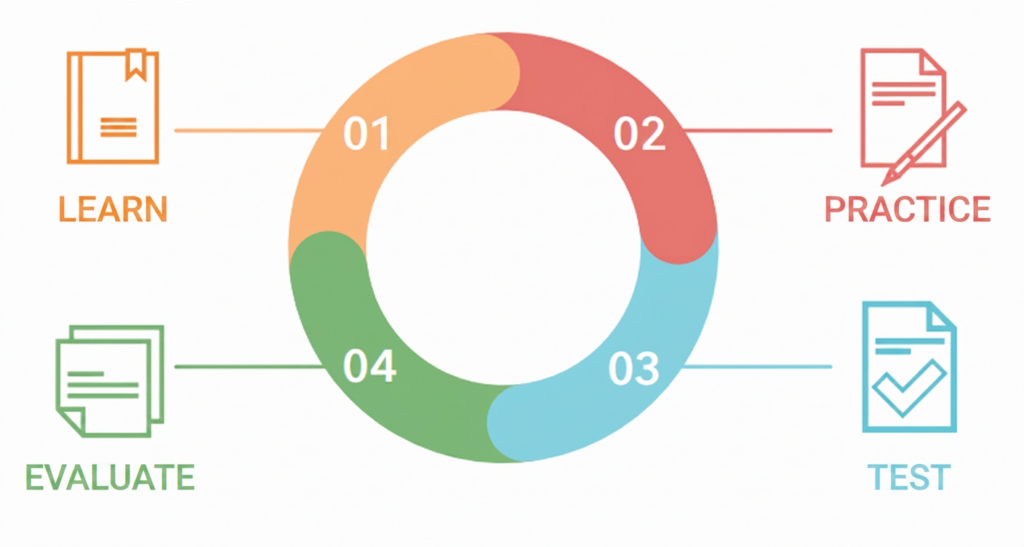
Our 1-on-1 online summer math program includes a complete learning loop: assessment, teaching, practice, feedback, review, and progress tracking. With the right support, students can practice targeted problems, review mistakes, and adjust their learning plan as they improve.
5. Fits Around Summer Schedule
Many summer programs have fixed schedules, fixed pacing, and fixed curricula. But families often have plans of travelling or camping, and those may be changed from time to time. So students do favor the way that fits their goals.
So a more flexible format is needed. We offer weekly review, short-term intensive learning, or back-to-school preparation based on students’ availability.
Review, Preview, or Competition Prep: Which Summer Path Is Right?
Not every student should use summer in the same way.
Some students need to strengthen key foundations, while others are ready to learn ahead or take on more challenging problem-solving.
The best summer math path depends on your child’s current level, confidence, and goals for the upcoming school year.
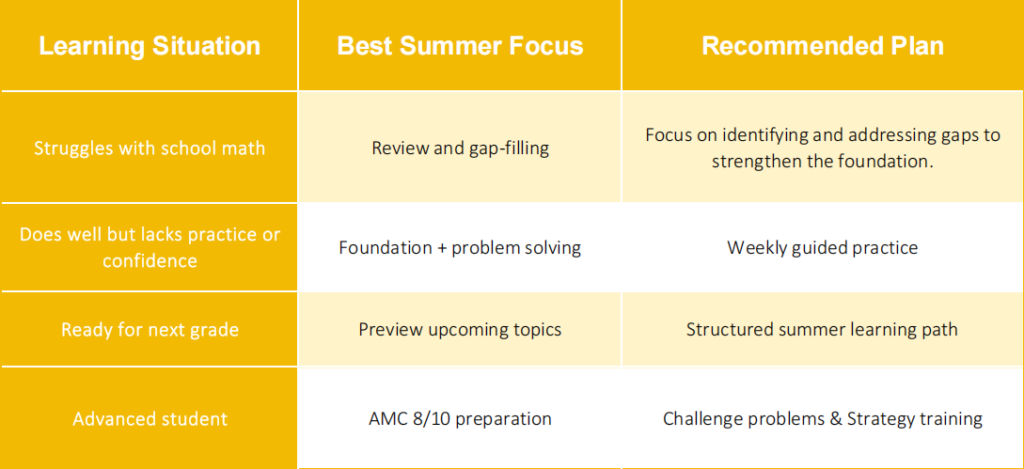
Use the table below to identify which path may fit your child best:
Recommended Summer Math Plan by Grade Level
To build the right summer math plan, start with your child’s incoming grade:
Grade 6 Grade 7 Grade 8Then choose the learning track that best matches their current level.
Rising 6th Grade Summer Math Plan
6th grade is a major transition into middle school math. Students move from arithmetic into more abstract thinking. Key topics include:
Grade Focus
- Ratios and rates
- Percentages
- Area of parallelograms, triangles, and other shapes
- Expressions and equations
- Basic statistics and data interpretation
A strong summer plan should help students connect calculation skills and geometric thinking with reasoning and real-world problem solving.
Summer Plan by Track
Catch Up
Students who still have gaps in fractions, decimals, division, or basic percentages will need this plan. The summer plan should first repair these foundations because they directly affect ratios, rates, and pre-algebra.
Stay on Track
Those who want a smoother transition into middle school can follow this plan. The plan should focus on ratios, rates, percentages, area of triangles, and early expressions so students feel prepared for G6 math.
Move Ahead
This is for students who are ready for a challenge. The plan can preview equations, integers, coordinate plane concepts, and pre-algebra problem solving. For stronger students, AMC 8-style problems can be introduced gradually.
What Think Academy 1-on-1 Can Provide
Think Academy 1-on-1 supports the transition into middle school math by focusing on ratios, rates, percentages, rational numbers, and early algebra. Tutors identify whether a student needs review or preview, then adjust lessons based on progress.
Rising 7th Grade Summer Math Plan
Grade Focus
Rising 7th grade is a key year for pre-algebra development. Many students start to feel the gap between memorizing procedures and truly understanding math. Key topics include:
- Proportional relationships
- Operations with rational numbers
- Expressions and linear equations
- Scale drawings
- Area, surface area, and volume
- Statistics and probability
- Multi-step word problems
These skills are essential for success in Algebra 1.
Summer Plan by Track
Catch Up
Suitable for students who struggle with fractions, ratios, percentages, integers, or basics of equations. The summer plan should focus on rebuilding these skills before moving into more advanced pre-algebra topics.
Stay on Track
For students who want to strengthen 7th-grade readiness, the plan should cover proportional reasoning, rational number operations, expressions, equations, and geometry applications.
Move Ahead
This is best for students who are ready for advanced math. The plan can preview linear equations, graphing, algebra readiness topics, and AMC 8-style problem solving. This track is especially useful for students aiming for math placement tests.
What Think Academy 1-on-1 Can Provide
Think Academy 1-on-1 helps rising 7th graders build stronger pre-algebra skills, including proportional relationships, rational number operations, expressions, equations, and geometry applications.
Rising 8th Grade Summer Math Plan
Grade Focus
Rising 8th grade is the bridge to Algebra I and high school math. Students need stronger algebraic thinking, graphing skills, and geometric reasoning. Key topics include:
- Expressions and equations
- Linear equations
- Systems of equations
- Functions
- Graphing linear relationships
- Geometry with angles, similarity, and congruence
- Pythagorean Theorem
Summer is a valuable time to decide whether the student should review pre-algebra, preview Algebra I, or begin competition-style training.
Summer Plan by Track
Catch Up Track
For students who are not fully confident with rational numbers, proportions, expressions, or equations. The summer plan should focus on closing pre-algebra gaps before Algebra I becomes more demanding.
Stay on Track
This is for students preparing for regular 8th grade math or Algebra I readiness. The plan should strengthen linear equations, functions, graphing, geometry foundations, and multi-step algebra word problems.
Move Ahead
This track is for students who are already strong in pre-algebra. The plan can preview Algebra I topics, including equations, inequalities, functions, systems, and more complex applications. Students interested in competitions can also begin AMC 8 or early AMC 10 preparation depending on their level.
What Think Academy 1-on-1 Can Provide
Think Academy 1-on-1 helps rising 8th graders prepare for Algebra I by strengthening linear equations, functions, graphing, systems, geometry, and multi-step problem-solving. Based on the student’s level, the plan can adjust flexibly.
Need A Plan?
What a Personalized Summer Math Plan Looks Like at Think Academy 1-on-1
A strong summer math plan should not be a fixed worksheet packet or a one-size-fits-all class. At Think Academy 1-on-1, each student’s plan starts with their current level, learning gaps, school goals, and schedule.
After a diagnostic assessment, students receive a personalized learning plan that outlines what they will study and why.
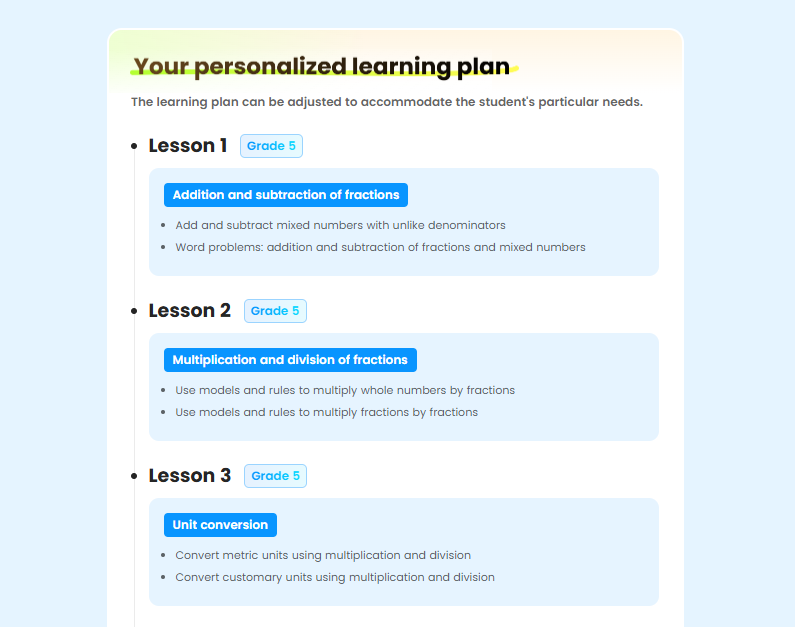
The plan can be adjusted as the student progresses.
If a student needs more review, the tutor can slow down and reinforce the foundation.
If the student masters a topic quickly, the plan can move into enrichment, advanced problem solving, or AMC-style questions.
Think Academy 1-on-1 supports different goals, including:
- Foundational Support: close learning gaps and keep pace with school math
- Enrichment: get ahead of the school curriculum
- Pre-Algebra to Algebra II Pathways: prepare for advanced or honors tracks
- Math Competitions: build problem-solving skills for AMC 8 or AMC 10
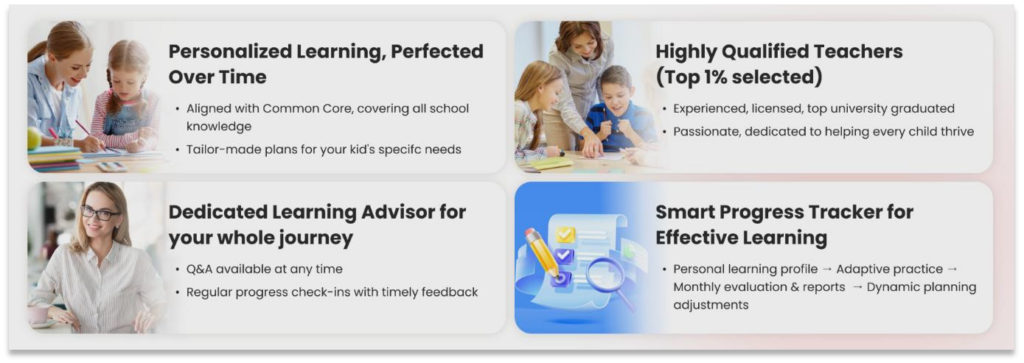
Students are supported by 1-on-1 instruction, a private learning advisor, experienced math teachers, and progress tracking.
This helps families clearly see what the student is learning, where they are improving, and what the next step should be. For grades 6–8, this personalized approach makes summer math more focused, flexible, and effective.






