The American Math Competition 8 (AMC8) stands as one of the most recognized middle school math competitions in the U.S. and internationally, drawing hundreds of thousands of students each year who are eager to test their mathematical reasoning beyond classroom curriculum.
Far more than just a contest, it builds critical problem-solving skills, strengthens core middle school math foundations, and serves as a natural stepping stone for students looking to explore competition math before advancing to the AMC 10 and AMC 12.
In this guide, we’ll break down everything you need to know about the 2027 AMC 8 — from exam format and scoring to common misconceptions — to help you approach the competition with confidence and set your up for success.
What Is AMC 8?
Short for the American Mathematics Competitions 8, the AMC 8 is organized by the Mathematical Association of America (MAA) — the same organization that launched the broader AMC program back in 1950.

First introduced in 1985 as an entry-level contest for younger students, it was originally created to identify and nurture early mathematical talent, feeding into the pipeline for the U.S. Olympiad team. Nearly four decades later, it has grown into a global phenomenon, drawing over 300,000 participants across 30+ countries each year.
Designed specifically for middle school students who enjoy math problem solving, the AMC 8 focuses on mathematical reasoning rather than routine school math — requiring students to think creatively, connect concepts across topics, and apply logic in unfamiliar contexts. It also serves as an early pathway to higher-level contests such as the AMC 10, AMC 12, AIME, and beyond, giving younger students a low-stakes first taste of competition math before they advance to more challenging exams.
Now, let’s walk through the test format so you know exactly what to expect on exam day:
| Item | Details |
| Number of Questions | 25 |
| Time Limit | 40 minutes |
| Question Type | Multiple choice |
| Calculator | Not allowed |
| Total Score | 25 points |
| Scoring | 1 point for each correct answer |
| Penalty for Wrong Answers | No penalty |
📌 Cautions:
- No calculators allowed. Calculators of any kind are strictly prohibited; every problem is designed to be solved with mathematical reasoning alone.
- Permitted materials: standard writing utensils, erasers, blank scratch paper (provided by the proctor), and rulers.
- Prohibited items: all electronic devices (cell phones, smartwatches), compasses, protractors, textbooks, and reference notes.
- Timing & scoring: the exam is exactly 40 minutes long, and there is no penalty for incorrect answers.
- No content disclosure: sharing or discussing exam content publicly before 8 a.m. ET the day after the competition window closes is a serious rule violation.
Who Is Eligible for AMC 8?
To compete in the AMC 8, students must be in grade 8 or below and under 14.5 years of age on the official competition day, as set by the MAA. This dual requirement ensures the contest remains age-appropriate and accessible for middle school learners across different academic tracks.
Homeschooled students and international students are fully eligible to participate, but registration must be completed through an officially approved school or authorized test center — individual direct registration is not available through the MAA.
Why do Students Take AMC 8?
The AMC 8 is far more than a single contest; it is a strategic investment in a student’s mathematical growth, academic trajectory, and competitive future. Below are three core reasons students and families choose to participate.
1. Improve Math Ability
At its core, the AMC 8 builds deep, flexible mathematical thinking that extends well beyond standard classroom math.
Rather than drilling routine calculations, students learn to apply logical reasoning, pattern recognition, and multi-step problem solving to novel scenarios. This process strengthens middle school math foundations — from arithmetic and algebra to geometry and combinatorics — while fostering analytical habits that benefit every STEM subject long term.

2. Support Long-Term Academic Planning
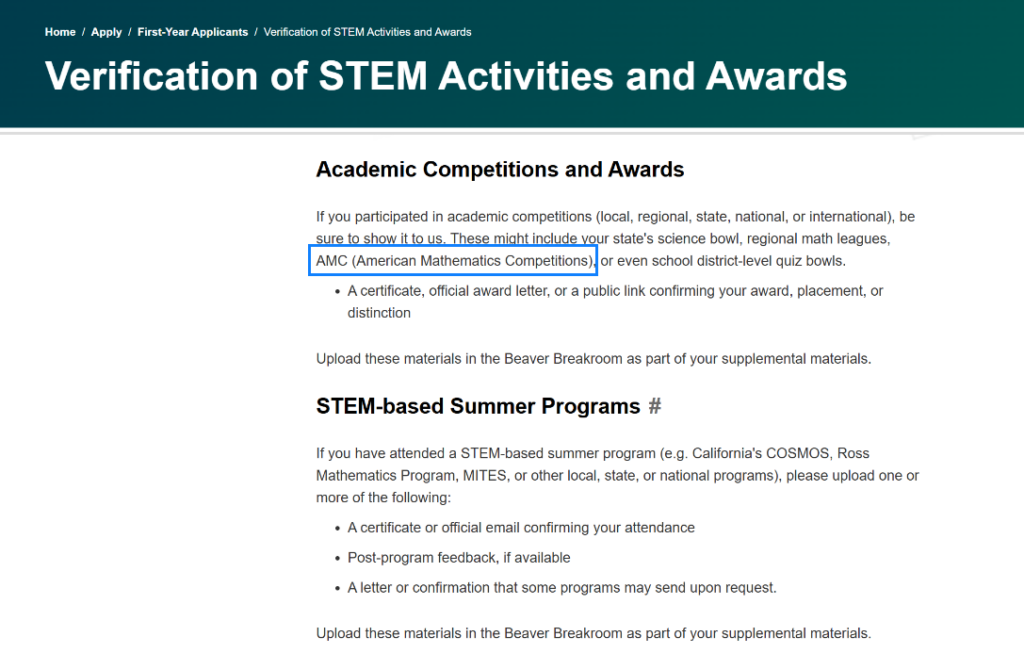
Strong AMC 8 performance is a credible, globally recognized marker of mathematical aptitude that enhances a student’s academic profile. For students planning to apply to competitive high schools, magnet programs, or eventually U.S. colleges, a solid AMC 8 record demonstrates intellectual curiosity and quantitative rigor. It signals to admissions committees that the student has challenged themselves beyond the standard curriculum and thrived in a rigorous, nationwide assessment.
3. Prepare for Future Math Competitions
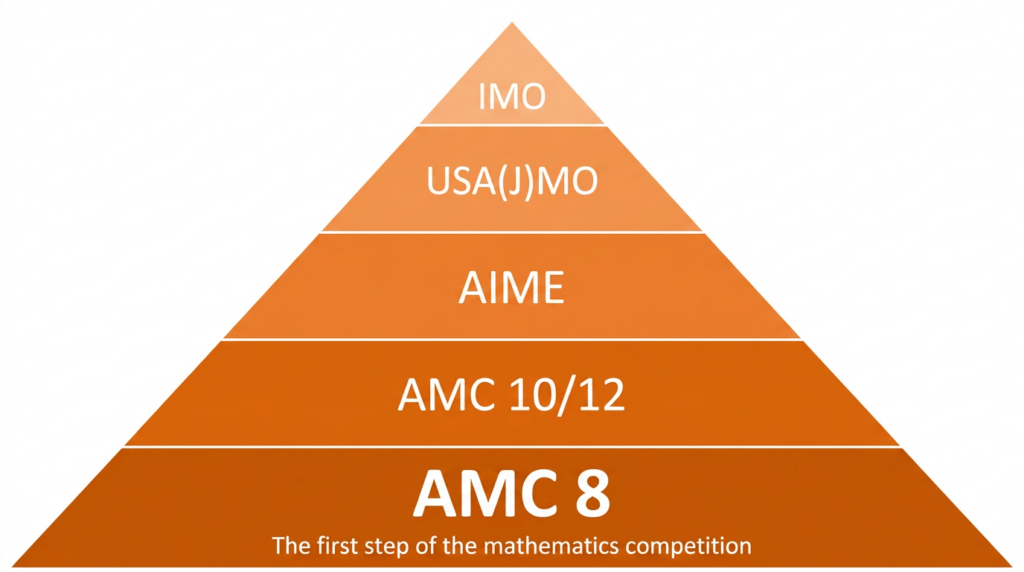
The AMC 8 is the official first rung on the MAA competition ladder, making it the most natural starting point for students aiming for higher-level contests. It introduces competition-style problem sets, time pressure, and test-taking strategy in a low-stakes, age-appropriate format. Students who build experience here transition much more smoothly to the AMC 10, AMC 12, and eventually the AIME — and for top performers, the pathway extends all the way to the USA(J)MO and the IMO (International Mathematical Olympiad).
2027 AMC 8 Date and Registration Information
When Is the 2027 AMC 8
January 21 – 27, 2027
How to Register for the 2027 AMC 8 in U.S.
Unlike most standardized assessments, students cannot register for the AMC 8 individually and directly with the MAA.
All U.S. entries are managed exclusively through official MAA-approved test centers, where a designated Competition Manager submits student rosters, secures exam materials, and oversees test administration. For students based in the U.S., registration is typically accessible through four primary channels:
- School math departments: The most common registration route. Most public, private, and charter middle schools that host the AMC 8 coordinate sign-ups internally through their math faculty. Reach out to your math teacher or department head to confirm your school’s test site status and sign-up process.
- Local AMC test centers: If your school does not host the contest, you may register through nearby authorized testing locations, including local colleges, universities, and community math circles registered with the MAA.
- Approved learning centers: Many accredited after-school math programs and tutoring institutions operate as official AMC test sites, accepting registrations from students whose schools do not offer the exam.
- Homeschool or community testing groups: Homeschooled students are fully eligible to participate, but must register through an approved homeschool cooperative, community testing group, or other authorized site — individual families cannot register directly as a test site with the MAA.
Note:You can use the official AMC search tool to find a test center near you by ZIP code. Please note that the tool is only available during the active registration period.
Registration Deadline
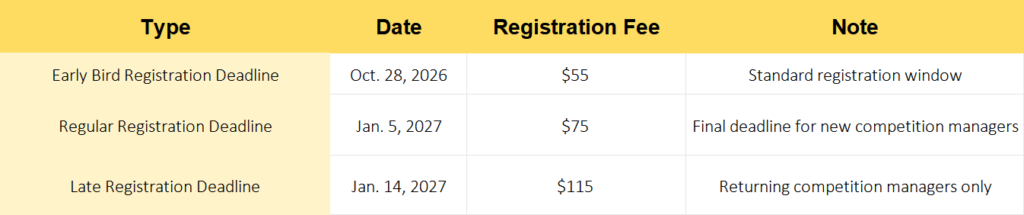
To help you plan your preparation schedule and avoid missed cutoffs or late registration fees, we have outlined the official 2027 AMC 8 U.S. registration timeline and pricing structure in the table below:
Scoring and award levels
Explain Score Interpretation
The AMC 8 consists of 25 multiple-choice questions, with a maximum possible score of 25 points. And scoring is straightforward: one point is awarded for each correct answer, and zero points are deducted for incorrect or unanswered questions. Since there is no guessing penalty, students are encouraged to attempt every problem, even when uncertain — a strategic guess can never hurt and may improve the final score.
Raw scores are then converted into global percentile rankings, which determine official award recognition. Cutoff scores vary slightly from year to year based on overall participant performance, and recent competitions have seen gradually rising thresholds as the contest grows more competitive globally.
Awards
The MAA recognizes top performers across three primary award tiers:
- Distinguished Honor Roll (DHR): Granted to students scoring in the top 1% of all participants worldwide. This is the highest distinction at the AMC 8 level and represents exceptional mathematical reasoning ability.
- Honor Roll (HR): Awarded to students placing in the top 5% globally. It is a widely respected benchmark that signals strong problem-solving proficiency.
- Achievement Roll (AR): A special recognition for students in grade 6 or below who achieve a qualifying score. This award celebrates younger students who demonstrate advanced mathematical talent ahead of their grade level.
All participants receive an official score report, and schools also receive summary data for institutional benchmarking.
What Math Topics Are Covered in AMC 8?
The AMC 8 is built around standard middle school mathematics content, but framed to test logical reasoning over rote memorization. The exam spans seven core topic domains, each outlined below with key representative concepts:
- Numbers & Operations: Foundational computational skills including integer arithmetic, fraction and percentage calculations, and divisibility rules.
- Algebra: Basic algebraic expressions, linear equations, functions, and ratios & proportional relationships.
- Geometry: Properties of 2D shapes, area and perimeter of composite figures, and angle relationships paired with the Pythagorean theorem.
- Number Theory: Prime factorization, greatest common factor (GCf) / least common multiple (LCM), and remainder pattern problems.
- Counting & Probability: Systematic counting methods, basic probability calculation, and complementary counting strategies.
- Combinatorics: Permutations of distinct objects, elementary combinations, and casework-based counting logic.
- Word Problems: Real-world applied scenarios such as rate problems and age problems, requiring students to translate verbal descriptions into mathematical models.
With a clear picture of the full tested content scope, we can now turn to the 2026 exam results and emerging question trends to identify which topics are growing in emphasis — and what that means for your 2027 preparation plan.
Brief 2026 AMC 8 Trend Analysis
Drawing on question patterns and performance insights from the 2026 AMC 8, we’ve broken down the latest exam trends to help you target your 2027 preparation effectively.
Overall Exam Trends
Looking at AMC 8 module weightings over the past five years:
Word problems and geometry remain reliably high-frequency topics, while the share of other modules fluctuates significantly from year to year.
Focusing only on these commonly tested areas is far from enough to earn a top score. To reach an advanced level, you need to thoroughly master each module without any knowledge gaps, so you can confidently handle various question variations that may appear on the exam.
For 2026 specifically:
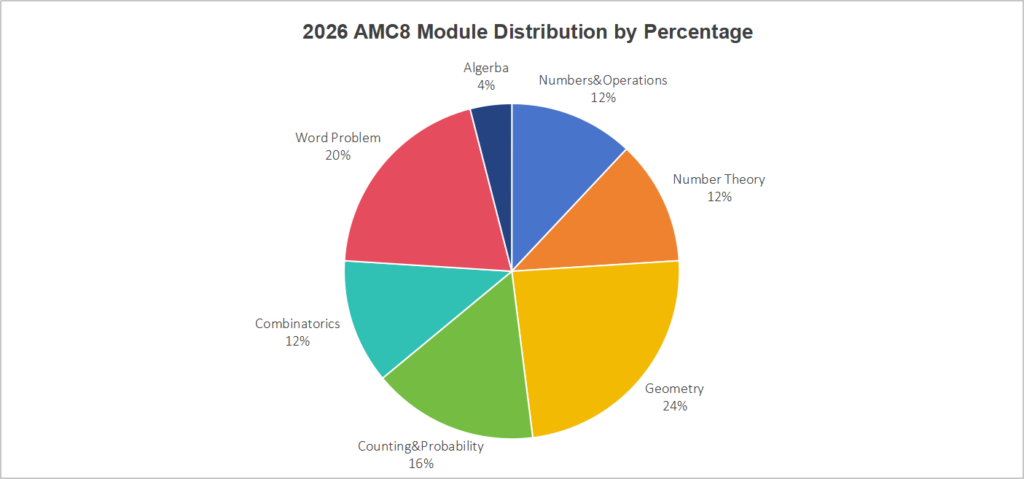
- Overall difficulty was comparable to the prior year. Questions 1–10 stayed relatively accessible, while medium-difficulty questions became slightly more rigorous.
- Middle school-level concepts — including square roots, extended algebra, inequalities, and Diophantine equations — appeared more frequently, benefiting students who have been introduced to these topics ahead of the standard curriculum timeline.
Difficulty Breakdown by Question Range
📌Questions 1–9:This opening set was generally straightforward, assessing basic, school-level knowledge such as arithmetic grouping tricks, square root simplification, and direct calculation. These items reward speed and accuracy with foundational skills.
📌Questions 10–18: The mid-test section focuses heavily on two core modules: geometry and counting, probability & statistics. The probability and statistics questions in this range were notably challenging: core concepts are packaged in contextual scenarios, requiring students to first extract and reframe information before applying their core knowledge to reach a solution.
📌Questions 19–25: The difficulty of this final and most advanced section was similar to that of 2025. There were no questions that were extremely difficult or beyond the expected scope. In earlier years, the hardest problems most often came from the counting/probability and statistics module, but this has not been the main source of late-test difficulty over the past two years.
Key Takeaways for 2027
Though overall difficulty has held steady year over year, the exam now spans a wider range of middle school concepts and calls for deeper mastery of core knowledge.
To score well on the AMC 8, students need both comprehensive coverage of all modules and knowledge points, as well as calculation fluency and strong conceptual understanding. After solving basic questions efficiently and accurately, the ability to tackle cross-module, multi-step challenging problems is the deciding factor for achieving top scores and official awards.
Common AMC 8 Misconceptions
Many students approach the AMC 8 with assumptions that hold back their progress. Clearing up these five common myths will help you study smarter, not harder.
📌Mistake 1: Starting Too Late
The AMC 8 goes well beyond standard middle school math in both depth and problem-solving style. Waiting until a month before the contest to prepare often leaves students overwhelmed by new concepts and strategies.

📌Mistake 2: Only Practicing Hard Problems
Challenging problems alone won’t secure a high score. Easy and medium questions make up the majority of the test, and careless errors on these items cost far more points than missing a single difficult problem. Consistent practice across all difficulty levels builds both speed and accuracy.
📌Mistake 3: Relying Too Much on Formulas
Unlike routine school math, the AMC 8 rewards flexible reasoning over memorization. Most problems cannot be solved by simply plugging numbers into a formula. Success depends on logical thinking, pattern recognition, and the ability to adapt known concepts to unfamiliar scenarios.
📌Mistake 4: Poor Time Management
With only 40 minutes for 25 questions, pacing is critical. Students who get stuck on a single hard problem often rush through easier ones and lose easy points. Knowing when to skip a question, mark it for later, and work through the test strategically makes a noticeable difference in final scores.
Test-Day Tips for the 2027 AMC 8
Now that you know which pitfalls to avoid during preparation, let’s cover actionable test-day strategies to help you perform at your best when it matters most.
Practical Tips
- Read every question carefully.
- Do not spend too long on one problem.
- Mark difficult questions and return later.
- Use diagrams when possible.
- Since there is no penalty, answer every question.
- Check simple calculations if time allows.
- Stay calm if the final questions feel challenging.
Parent Reminder
Parents should help students sleep well the night before and avoid last-minute pressure. Confidence and calm thinking are important for competition performance.
How Think Academy 1-on-1 Help Students Prepare for AMC 8
Think Academy 1-on-1 Online Math Tutoring offers personalized, structured courses based on individual needs. It provides you with a reliable 1-on-1 teaching service escorted by professional American teachers and dedicated learning advisors. The service also includes a complete learning tracking system and a customer-friendly refund policy.

With so many topics to cover and common pitfalls to avoid, a structured study plan makes all the difference. Our 1-on-1 AMC 8 Intensive Prep program guides students through a proven three-stage pathway — knowledge breakdown, modular consolidation, and Practical training — aligned directly with official contest patterns.
Our curriculum covers every core AMC 8 domain: arithmetic & algebra, geometry, number theory, counting & probability, combinatorics, and word problems, followed by advanced modules and two full-length mock tests to build pacing and stamina.
Because it is delivered 1-on-1, every lesson is tailored to the student’s current level, gaps, and award target — whether building foundational reasoning or targeting the awards.
Ready to gauge your AMC 8 readiness?
Book a complimentary diagnostic assessment with an experienced instructor. You’ll receive a detailed breakdown of strengths, growth areas, and a personalized preparation roadmap for the 2027 exam.
Frequently Asked Questions (FAQ)
Q1.Is the 2027 AMC 8 online or in person?
The MAA offers both in-person and online administration options. The format available to a student depends on their registered test center; most schools and local testing sites offer in-person testing, while some authorized centers provide remote proctored online exams.
Q2. Can students use a calculator on the AMC 8?
No. Calculators of any kind are strictly prohibited. Every problem is designed to be solved with mathematical reasoning and basic arithmetic; no question requires computational tools.
Q3.Is AMC 8 difficult?
The exam is designed to be challenging for middle school students. Questions increase in difficulty from start to finish: the first 10 problems are generally accessible, while the final 5–8 problems require stronger problem-solving skills and separate top performers.
Q4.How long is the AMC 8?
The AMC 8 is a 40-minute timed contest consisting of 25 multiple-choice questions.
Q5.What are the differences between AMC8 and school mathematics?
School math typically focuses on procedural fluency and routine exercises, while the AMC 8 emphasizes logical reasoning, creative problem solving, and cross-topic application. Problems are often presented in novel contexts that cannot be solved by memorizing formulas alone.
Q6.What grade should students start preparing for AMC 8?
Most students begin structured preparation in 6th or 7th grade, but motivated learners can start as early as 4th or 5th grade with foundational competition math. The ideal starting point depends on a student’s current math fluency and target score.
Q7.Is AMC 8 useful for AMC 10 preparation?
Absolutely. The AMC 8 is the official first step on the MAA competition ladder. It builds competition-style thinking, test-taking strategy, and core content knowledge that directly carry over to the AMC 10, making the transition smoother and less intimidating.
Q8. What is the best way to prepare for AMC 8?
The most effective approach combines three elements: systematic coverage of all content modules, consistent practice with official past exams under timed conditions, and thorough review of mistakes to close knowledge gaps. Building conceptual understanding rather than just memorizing formulas yields the best long-term results.






