5th-grade fraction word problems can be difficult because students must have two abilities: understanding fractions and understanding the story in the problem. Many students know how to calculate fractions, but struggle to decide which operation to use.
This guide will show parents how to help children understand, organize, and solve fraction word problems with more confidence.

1. Start by Checking Fraction Understanding
Many 5th graders can follow steps for fraction calculations but still struggle when fractions appear in word problems because they are not clear about what the numbers mean.
Fractions are students’ first major transition from whole numbers to non-whole numbers. Unlike whole numbers, fractions describe parts of a whole — which means students must grasp the concept of equal sharing before fraction operations can become meaningful.
A key point for parents to remember: fractions are not just “two numbers stacked on top of each other.” The numerator and denominator work together to describe a quantity.
| For example, in the fraction3/4: The denominator, 4, tells us the whole is divided into 4 equal parts. The numerator, 3, tells us we are talking about 3 of those equal parts. |
Once your child can clearly explain what the numerator and denominator mean, they will be much better prepared to understand the word problem and choose the correct operation.
2. Understand the Situation First
Before calculating, help your child slow down and understand the situation. Many 5th graders rush to pick an operation as soon as they see numbers, but fraction word problems require students to know what the fraction is describing and what the question is really asking.
| For example: A student drank 3/4 of a bottle of water. How much of the bottle did the student drink? At first, this problem looks simple. But it still requires the child to understand the relationship between the fraction and the whole. |
One helpful way to guide your child is to ask short, concrete questions. These questions help them organize the story before choosing an operation:
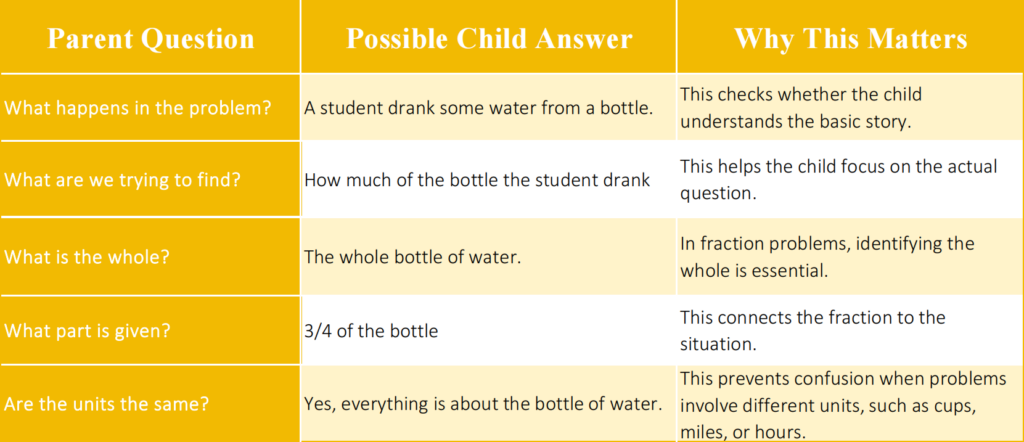
This step may feel slow at first, but it helps children avoid a very common mistake: solving before understanding.
If a child cannot explain the situation in simple words, they are more likely to choose the wrong operation or misunderstand what the answer should represent.
3. Use Visual Models Before Abstract Equations
Then, help them turn the situation into a picture before writing an equation.
For many 5th graders, visual models make fraction relationships easier to understand because they show why an operation makes sense.
A visual model is not just a drawing or decoration. It helps students see the quantities, the whole, and the parts. This is especially useful because students may not be able to tell whether an answer should be larger or smaller just by looking at the numbers.
Useful visual models include:
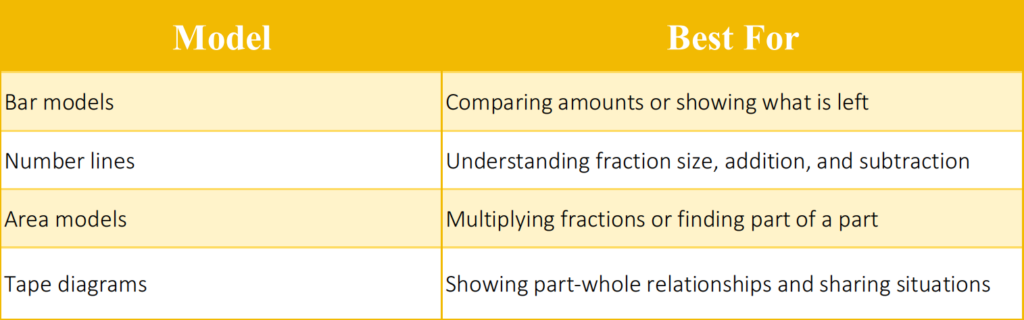
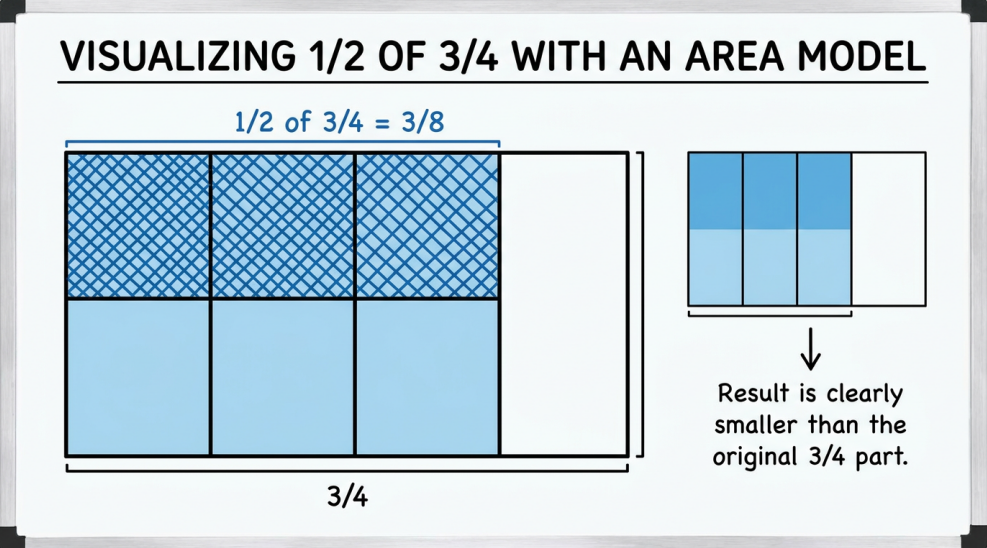
For example, if a problem asks for 1/2 of 3/4, an area model can help students see that the answer should be smaller than 3/4. This makes the equation more meaningful instead of feeling like a memorized rule.
4. Help Your Child Match the Operation to the Meaning
After using a visual model, help your child turn the picture into an equation. The key is to connect the operation to what is happening in the problem, not just to a keyword.
Avoid asking, “Should we add, subtract, multiply, or divide?” right away. Instead, use simple guiding questions to help your child understand the situation first. The goal is to help your child build a habit: understand the meaning first, then choose the math.
The table below shows how common problem situations connect to simple parent questions and likely operations.
| Situation in the Problem | Simple Question to Ask Your Child | Likely Operation | Example Problem |
| Two or more fraction amounts are being put together | “Are we putting these amounts together?” | Addition | Mia used 1/3cup of sugar and 1/2 cup of flour. How much did she use in all? |
| One amount is being taken away | “Did something get used, eaten, or removed?” | Subtraction | Jack had 3/5 of a pizza. He ate1/5. How much is left? |
| The problem asks for part of a quantity | “Are we finding a part of something?” | Multiplication | Lily read 2/3 of a 30-page chapter. How many pages did she read? |
| Something is being shared equally | “Are we splitting it into equal groups?” | Division | Three friends share 1/2 of a cake equally. How much does each friend get? |
5. Teach a Repeatable Problem-Solving Routine
Once your child understands the situation and knows how to choose an operation, give them a simple routine they can use for every fraction word problem. A consistent process helps students organize their thinking and avoid jumping straight into calculation:
- Read the problem carefully.
Make sure your child reads the whole problem, not just the numbers. - Identify what is being asked.
Have them point to or underline the actual question. - Circle the key information.
Fractions, whole numbers, and units like cups, miles, hours, or pages all matter. - Choose the operation.
Decide whether the problem is asking to combine, compare, take away, find part of an amount, or share equally. - Solve the problem.
Write the equation clearly and calculate step by step. - Check if the answer makes sense.
Ask: “Is the answer reasonable?” “Does the unit match the question?” “Should the answer be bigger or smaller?”
This routine is especially useful for multi-step fraction word problems. Some students are eager to solve quickly and may skip important steps. By following the same process each time, they can learn to work more carefully and become more independent.
6. Practice by Problem Type Before Mixing Everything Together
When students are struggling with fraction word problems, mixed worksheets can feel overwhelming. Practice one problem type at a time so your child can focus on the meaning of each operation before switching strategies.
Start with one category, such as:
- adding fractions in word problems;
- subtracting fractions in word problems;
- multiplying a fraction by a whole number;
- dividing fractions in sharing situations.
Once your child can solve each type with confidence, move on to mixed practice and multi-step fraction word problems. This helps them transfer what they have learned and decide which operation to use without being told in advance.
If you’d like extra practice, enter your email below to get our Free Fraction Worksheets for 5th grade students.
Valid Email for Free Fraction Worksheets
7. When Parents Should Consider Extra Help
If you have already reviewed the basics, practiced different problem types, and introduced a clear problem-solving routine — but your child still gets stuck repeatedly — it may be time for more targeted support.
Extra help may be useful if your child:
- guesses which operation to use in word problems;
- cannot explain their reasoning;
- struggles with multi-step fraction problems;
- makes the same type of mistake again and again;
- loses confidence or avoids fraction homework.
A tutor can help identify the real source of the difficulty. Sometimes the issue is understanding fractions; other times it may be reading comprehension, choosing the right operation, calculation fluency, or problem-solving strategy. With the right diagnosis and support, students can rebuild confidence and make steady progress.
Schedule for Free Diagnostic Assessment
About Think Academy 1-On-1
Think Academy’s 1-on-1 Online Math Tutoring offers personalized, structured courses based on individual needs. It provides reliable 1-on-1 teaching service escorted by professional teachers and dedicated learning advisors. The service also includes a complete learning tracking system and a customer-friendly refund policy.

This course is built exclusively for fifth‑grade learners. Our teachers unpack challenging fraction word problems step by step. They guide students to spot key values in each problem and turn real‑world scenarios into clear math equations.
Beyond fraction word problems, personalized lessons cover all core Grade 5 math topics, adapt to each child’s learning pace, fill knowledge gaps promptly, and equip students with lasting problem-solving strategies.
FAQ
Q1: Why are fraction word problems difficult for many 5th graders?
Fraction word problems are challenging because students need to understand both the math and the story. They must identify the whole, understand what the fraction represents, and decide which operation makes sense. Many students can calculate fractions in isolation but struggle to apply them in real-world situations.
Q2: How can I help my child choose the right operation in a fraction word problem?
Instead of asking your child to look for keywords, ask what is happening in the problem. Are amounts being combined, compared, shared, or used as part of another amount? Once students understand the situation, choosing addition, subtraction, multiplication, or division becomes much easier.
Q3: What other math topics are important in 5th grade?
In 5th grade, students typically work on fractions, decimals, multi-digit operations, place value, volume, coordinate planes, and problem solving. They are also expected to explain their reasoning more clearly than in earlier grades. This is an important transition year because students are preparing for more abstract math in middle school.
Q4: Why does my child struggle with decimal operations?
Decimal operations can be difficult because students must understand place value, not just follow steps. Many mistakes happen when children line up digits incorrectly or forget what each decimal place represents. Using money, number lines, and place-value charts can help decimals feel more concrete.
Q5: Why is volume a major topic in 5th grade math?
Volume helps students move from flat shapes to three-dimensional measurement. Students need to understand that volume measures the space inside a solid figure and is counted in cubic units. This topic also strengthens multiplication skills because students often use length, width, and height to find volume.
Q6: What should I do if my child keeps making careless mistakes?
First, check whether the mistakes are truly careless or caused by a concept gap. Ask your child to explain their thinking and show each step. If the mistake happens repeatedly, it may point to a specific issue, such as misunderstanding the operation or not checking the answer.
Q7: When should I consider getting extra math support for my 5th grader?
Extra support may be helpful if your child often guesses, cannot explain their reasoning, avoids homework, or loses confidence in math. It may also be useful if they repeatedly struggle with multi-step problems or make the same type of mistake. A teacher can help identify whether the issue is conceptual understanding, calculation fluency, reading comprehension, or problem-solving strategy.






